
All Episodes of The Curiosity Squad
May 18, 2026
The Curiosity Squad Episode 33 – Waterworks, Geocaching, Communications and Foraging
With school coming to a close for many in North Alabama this week, this episode provides a reminder of just how much fun Geocaching could be as a new hobby. We also hear from a fun environmental education place where you and your besties could go for a couple of hours, and we revisit the Signals Museum – an option for a rainy day. Host Alex Hall recently went out foraging with Casey Lanier and the Mulberry is featured in this episode.
Part 1: Foraging the Wild Mulberry (1:34)
Alex Hall Welcome to the Curiosity Squad taking you along as we get curious about science, nature, technology and more. I’m Alex Hall and this is a production of WLRH your local public radio. For many in North Alabama, this is the last week of school, so I thought it would be fun to think up some outdoor activities. Coming up later in the show, we’ll be learning about geocaching and exploring the environment. But first I visited our regular forager, Casey Lanier, to find out what was coming into season in the forest. So, Casey describe what we’re looking at.
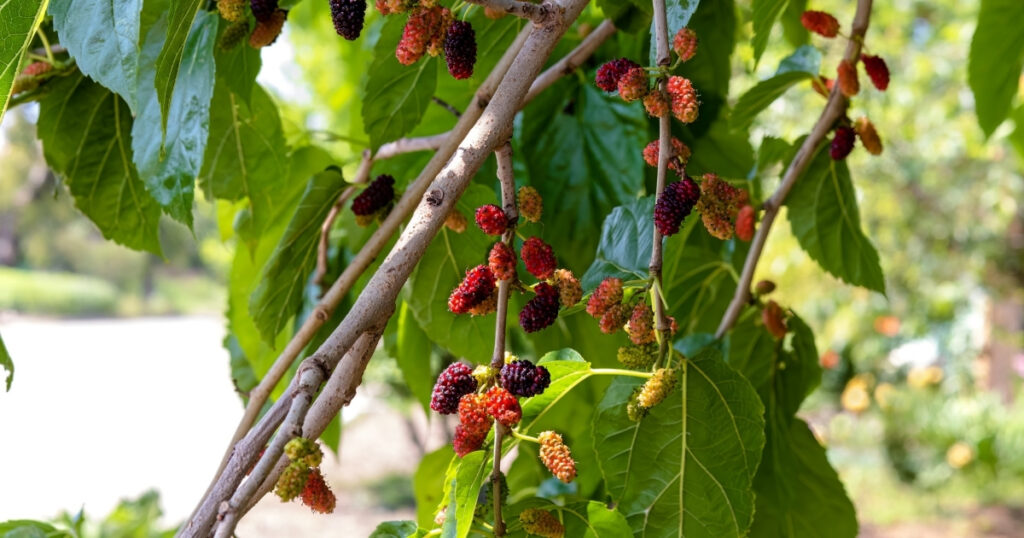
Casey Lanier So we are looking at not one but two mulberry trees. And if you notice, they’re not especially similar. And there’s a reason for that.
Alex Hall Yeah. The leaves look to be different.
Casey Lanier Yeah, they’re different in size. This one’s hairier, whereas this one is smoother. This one. The leaf tips are more acuminate, which is just fancy speak for pointy, whereas this one they don’t come to quite as strong of points. And that is because we have two species of mulberry in North Alabama. Um, the one with the bigger hairier leaves is morus rubra. American mulberry, the one with the less pointy, smaller leaves that are a little bit shinier maybe is Morus Alba, which is called Chinese or paper mulberry.
Alex Hall Has that one been introduced into Alabama? But maybe a long time ago.
Casey Lanier Yeah, it is invasive. Um, to me, on the scale of invasive plants, it’s not terrible seeing as it has multiple edible parts. It doesn’t really seem to overcome the natives in the way that some of our invasives do. And frankly, if it was the only invasive plant, maybe it would be worth spending effort to get rid of it, but it’s not. And there are so many more that are more worth our time to fight against. So today we’re just going to talk about how great it is. So for both of our mulberries, there are two edible parts. The one that we’re looking at right now is the leaves. So the young leaves on either plant are edible. So if we pinch some off, the American mulberry has a better flavor, but they’re a little bit hairy. I don’t quite love the texture. I want to try one.
Alex Hall Sure.
Casey Lanier Find one without a grasshopper on it. Okay.
Alex Hall Oh, it’s kind of weird with the.
Casey Lanier Yeah.
Alex Hall The fur.
Casey Lanier It reminds me of eating a piece of felt or something. But the flavor’s good. Some people will blend them up in smoothies or something that mask the texture a little bit and just get the nutrients and the flavor out that way. The invasive mulberry, the texture’s a little better. and the flavors a little worse. There are really some people’s favorite wild greens. I would not say so, but it’s a really cool, edible part of the tree.
Alex Hall So you would potentially just add that to a salad?
Casey Lanier Yeah. Um, just the other day I went for a walk at work and made a little wild salad out of leaves and berries and, uh, gave myself a little side dish to my sad desk. Ramen.
Alex Hall So when does the mulberry tree, uh, get berries?
Casey Lanier So the time is now. Um, these are too small. This will become a full size tree. But here at my house, this field’s only been growing up for about two years. So these trees are about six feet tall, roughly. And you could have a tree that produces at this height. But to find one that’s actually producing right now, and we’ll see if there are any ripe, we’ll have to swing over to the edge of the field where there are some older trees. So this is a large example of the invasive paper mulberry tree. Something you’ll see is the berries that are on it right now are white. The scientific name Morus Alba means white mulberry. It’s funny. That actually comes from sort of a misunderstanding. When the first English sailors and explorers and naturalists brought back mulberry specimens from China. They sent back a tree that the fruits ripened white and it got its name from that. But that tree was a one in a million aberration. Most mulberries, the fruit start white and then ripen to black. They look almost exactly like a blackberry. And in fact, unless you’re very, very imaginative, if you see something that looks like a BlackBerry that’s growing on a tree, it’s a mulberry and you can eat it. Always do your own research. Always double check your identifications. But it’s one of the safest things you could eat in the wild is blackberries that are growing on trees. Well, right now we’re running into the problem where there are plenty of berries on this tree that have already matured. But we are racing the birds because they are better at getting up in the branches than we are. And so all they leave for us most of the time is these more immature ones. I’ve talked about masting with you before, where some like hickory trees, especially around here or oak trees, will produce very heavily in some years and then less in others to maintain a lower population of the things that eat their fruit or nut, and then some years produce an excess. So they can’t all be eaten and they’ll go to seed. I haven’t read this, but from what I’ve observed, it seems like mulberries do more or less the same thing, where every few years you’ll just have a really good year and a lot of mulberry trees will make so much fruit that the animals can’t keep up. And that’s when we really get to stock up. The downside is they do have a little stem in the middle that you have to either ignore and eat or spit out. Also, if you’re making things out of mulberry and you just want the pulp, you can like smush it through a grater or strainer or something. I did want to mention, so I like to talk about some of the other uses of plants other than edibility. And the white mulberry in particular is a very significant tree in a lot of East Asian economies and cultures. So if you’ve ever heard of the silkworm silkworms eat primarily white mulberry leaves. It’s one of the only places where they’ll live. So they. White mulberries were cultivated in East Asia for silk for and have been for thousands and thousands of years. If you’re familiar with taxonomic rankings, it goes, you know, domain kingdom, yada yada, yada. All the stuff you learned in school to the only two we usually use when we’re talking about plants are genus and species. So with mulberry, that is Morus Alba and Morus rubra. Well, if you go one step up from there to family. Mulberry is related to Osage Orange. There are a few signs of that. One is that everything in the family that they’re in, which is Moraceae, has latex in pretty much all parts of the plant. So if we tear this guy off, you see how there’s a little bit of white latex coming out of the broken areas of the plant?
Alex Hall Oh, wow. Yeah, I see that. So actually, if you have a latex allergy, probably don’t go eating the mulberry.
Casey Lanier Yeah. That’s correct. Anything in this genus as well as your lettuces, there are a lot of plants with latex in them. Uh, similarly they both. So Osage Orange is well known as the best bow wood in North America for hunting bows, archery. Uh, mulberry is not as dense or hard as Osage, but it was used as the core component of a lot of Eastern Asian bows. So the Japanese Yumi, for example, is a very unique style of longbow that often would have used a mulberry core laminated with bamboo. Korean archers would have used a mulberry core laminated with horn and sinew, so animal parts to make an extremely advanced bow. It’s been a very significant tree for thousands and thousands of years, and we can still find it and eat it today.
Alex Hall As we usually also feature cases foraging in our morning show. Then you can find this feature on the Mulberry, as well as prior tree and shrub foraging notes in the Tennessee Valley Mornings archive. Those episodes can be found on our website at wlrh.org. Coming up next is our Land Trust Nature Minute.
Part 2: Visiting The Signals Museum (10:47)
Alex Hall Welcome back to the Curiosity Squad, a production of WLRH I’m Alex Hall. If you missed the first part of the show, you can always find it at dot org. Coming up later, we have our usual geek out locally and sky and space updates. And if you have a topic you’d like us to explore or a comment or question on what we’re doing, you can send me an email at curiosity squad at dot org. Exploring the forest and looking for edible plants is a great way to satisfy your curiosity. But what if it’s raining? We’re fortunate to have many fascinating places to explore that are indoors, and one of the newer ones here in Huntsville takes you on a journey that includes a vintage radio station.
Mark Bendixen I was the original founder. And now I do everything from cleaning floors to repairing radios. I love learning the technology of how things evolved and how we learn new things, and how we invented machines, and that to go to new opportunities.
Alex Hall Mark, what is the history of this museum? How did it get started?
Mark Bendixen It started probably when I was thirteen years old. I started working on radios and other electronic devices, and I built my first, uh, shortwave radio at that time. And then it evolved into a career in electrical engineering. And then all of a sudden I started thinking, well, I’m going to fix a couple more of these old radios and a couple more. And then my wife got involved with it also. And we had a fifty year career of, of buying and repairing old things. These are things from the past that we haven’t seen for many years in most cases. So we like bringing them out and let people look at them and have some memories.
Alex Hall And is it the case that an awful lot of these actually work.
Mark Bendixen Yes, we have over eighty five percent of them working right now. I’ve checked the first two or three hundred and we’re at over eighty five percent working at this point.
Alex Hall That’s really quite impressive. Let’s let’s go on a quick tour of the museum. My goodness. What is this mural, Mark?
Mark Bendixen Well, the mural is about the year eighteen twenty when communication was slow. And there’s a couple out here outside of Huntsville, we’re saying, and they’re trying to get a letter to a brother to let them know that mother was very sick. And it took a long time. You probably didn’t get mail every every couple of weeks or something like that. They’re waiting several weeks to get a response back from their brother. It’s so different from today when we have a cell phone, and in five seconds we can call anybody we want anywhere in the world.
Alex Hall Tell me about this interactive here, Mark.
Mark Bendixen This is sort of a take off on Guitar Hero. We call it Telegraph Hero, and allows two people to come up and tap the keys and see how quick their hands are at matching dots and dashes as the screen goes by and. And Mr. Morris, there’s an animation of Mr. Morris there, and he sort of makes fun of you if you’re not doing real well or he pat you on the back if you’re doing well.
Alex Hall So what kind of era are we in in this particular room? This is the the advent of telegraph, right?
Mark Bendixen Yes. This is all mid eighteen forties to the early eighteen fifties, sixty time frame when telegraph was early. Now most of our devices are starting about eighteen seventy. And going forward we don’t have the really early devices, but it gives you an idea of the keys, the Sounders, the relays that had to have in the older days, the kinds of technology that was involved in, in making telegraph work.
Alex Hall But of course, it got faster still. We’ve just walked into another room and now I’m seeing devices that look slightly familiar, including there’s an old trim phone over there too. So we’re now in our in the telephone part of the story. Tell me what we have here.
Mark Bendixen Well, we show what happened. We were able to send communication with telegraph by dots and dashes. But it was wonderful when we could all of a sudden send the voice, even though the bandwidth of the signals was pretty limited. You could pick up the phone receiver and you could recognize Aunt Martha’s voice or whatever it was. It was a wonderful technology, and it evolved fairly quickly. And as towns grew, they had to have switchboard operators. And then pretty soon automatic switchboards and all that kind of technology. So we sort of introduced those things. And the enjoyable part of this part of the museum is that young kids love it. They spend a majority of their time in this room talking to each other on these old phones.
Alex Hall And you have an old switchboard here, right? You can actually help out. Her name is Ma Bell. You can help her with routing her calls. Of course, switchboard operators got all of the gossip back then, didn’t they?
Mark Bendixen They did. They knew what was going on in the town. And, uh, you know, we we actually have it where you can sit down. Any operator can sit down in front of it, and Ma Bell sort of walks you through how to receive an incoming call, hook it up, and then listen to the parties if you’d like to.
Alex Hall If you’re just joining us, you’re listening to The Curiosity Squad, a production of WLRH in Huntsville. I’m Alex Hall, touring the Signals Museum with founder Mark Bendixen.
Music Echo for reliability.
Alex Hall We’re standing in front of a beautiful artifacts that I recognize as old phonographs. This is the history, presumably, of recorded sound. Tell us about this Mark.
Mark Bendixen Yeah. Recorded sound was being pursued all over the world. Different people took different approaches. Of course, we know Edison in this country was working with cylinder type shaped recording devices. And in Europe, Berliner and other people were working more with flat records that they pressed. And the technology was was amazing. You know, they, they started out with tin foil phonographs where they would record sound on a piece of tin foil, but it tore up very quickly. And then they started finding that the horns were sort of got in the way of things. And then finally they decided to put the horn inside the machine. As phonographs started encountering the competition from radio, they knew they had to get some ways of drawing the public to continue buying phonographs. And so the cabinetry became more beautiful, more more and more beautiful.
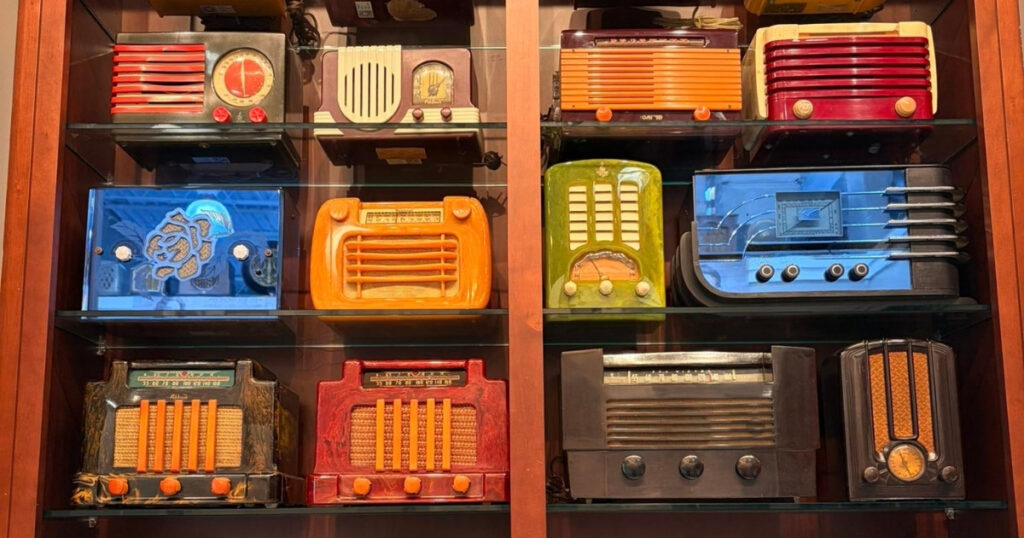
Alex Hall And we’ve now wandered into an area that is just full of radios. This must have seemed like magic at the time that you could get voice over the air. Talk to me about how radio got started. Who first realized that you could send voice on a radio signal?
Mark Bendixen Well, Maxwell, the Scottish mathematician in the eighteen sixties, he came up with the idea that, hey, we don’t need to have wires to send information. We can send it through the air, just like light goes through the air. They found that even the scientists at the time didn’t really believe that. They just didn’t believe it could happen that way. And it was about twenty five years later before they actually did experiments and started saying, wow, you really can send information. It’s, it’s electromagnetic energy. And it does go through the air and has properties just like light.
Alex Hall Tell me about this incredible radio shop that you have here.
Mark Bendixen In the early days of radio, it was you didn’t just buy a radio and have it all complete. You had to buy a separate speaker to go with it because it didn’t come with a speaker. You a lot of times had to buy the tubes separately. It didn’t come with the tubes. You always were wearing out batteries because they were battery driven. You’d have to come to the shop and buy batteries or buy a tube that were worn out. So cities had several radio shops. We sort of show a display here that what what it might look like in one of these stores.
Alex Hall Can you tell me a little bit about what we’ve got here? Mark.
Mark Bendixen Like all the other items, computer also evolved from the very early days when it was analog, before we had digital computers, we had analog computers with a bunch of wires in a in a patch board where we’d program up various kinds of equations and so on. And they were very helpful in the early days of NASA getting into the space age and so on. Uh, and then finally we got into the digital age and we started having early digital computers, the PDP series, PDP eight, PDP eleven. And then the microprocessors came along shortly after that. So computer, like everything else, evolved more and more until now. We have computers that fit in our pocket that do more than the large mainframe computers did of the day.
Alex Hall What are your hopes, Mark, when people come to the museum, what do you want them to go away having experienced? And what do you want them to go away thinking about?
Mark Bendixen Well, we say here that we like people to go away with a smile on their face. And it can be several things that cause that smile on their face. Uh, sometimes it’s seeing some old things that bring back Memories. Sometimes it’s learning something you never knew before. You start associating. Sometimes it’s seeing the cabinetry and saying, wow, that was beautiful. Cabinetry they had back in the thirties with kids. Sometimes it’s, oh, I got a chance to play an old video game or something like that. So there’s several different ways, but we like everybody to leave here with some enjoyable experience that they remember.
Alex Hall Well, thank you so much for taking me on a tour of this incredible gem here in Huntsville. I really appreciate your time today, Mark.
Mark Bendixen Well, you’re very welcome. We appreciate it.
Alex Hall Information on opening times and days can be found on the Signals Museum website at signals-museum.org. We also have the link on our website. Find this episode of The Curiosity Squad at wlrh.org on the Curiosity Squad pages. When we come back, we’ll be headed back outside.
Part 3: Exploring the WaterWorks Environmental Learning Lab (20:24)
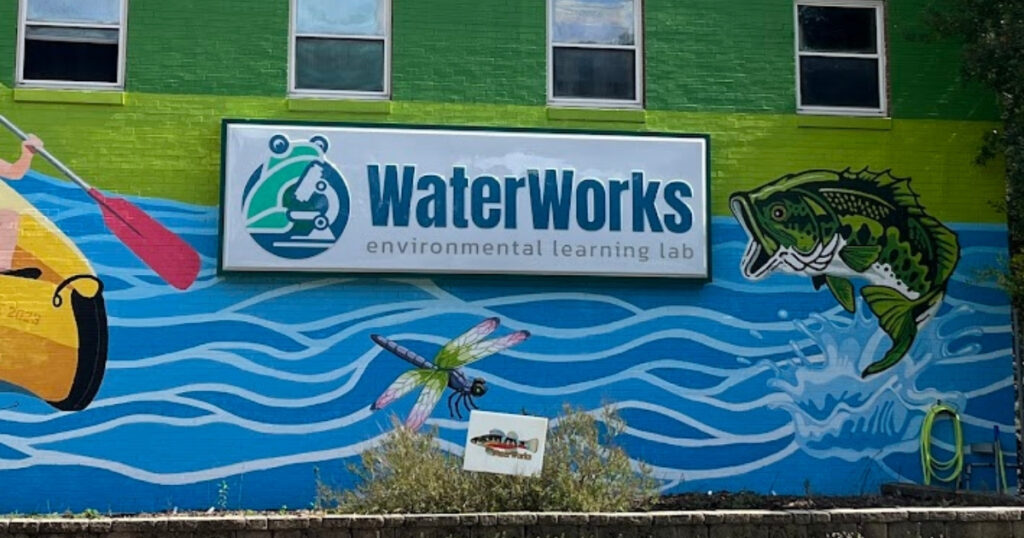
Alex Hall Welcome back to the Curiosity Squad, a production of WLRH I’m Alex Hall. Today we’re exploring some things to do when school gets out. If you’re just joining us, you can catch the show anytime on our website. Earlier this year, I went to check out Waterworks in Hartselle. An environmental learning lab. They have many fascinating opportunities to explore and learn for visitors who come as a pre-booked group. That sounds like an ideal opportunity to me for getting together with your school friends over the summer.
Kelly MacInnis Kelly MacInnis we’re with the Waterworks Environmental Learning Lab, which is a program of the Alabama’s Mountains, Rivers and Valleys Resource Conservation and Development Council.
Ella Absher My name is Ella Absher and I also work for the Waterworks Environmental Learning Lab.
Alex Hall So we are in the Waterworks Environmental Learning lab. Tell me about this pretty interesting building that we’re standing in.
Kelly MacInnis We’re in the former drinking water treatment plant for the city of Hartselle. It shut down in about nineteen ninety three because the water and the Flint Creek is too polluted. So up until nineteen ninety three, if you lived in the city of Hartselle, your drinking water was created in this building. It was cleaned here and then it would have been pumped to your house because the Flint Creek is now too polluted. That is not being created here anymore. So it is now this environmental education facility. Um, we host field trips and workshops, and we have a series of constructed wetlands that we pump water from the creek through our building. So our building is still doing some cleaning. It’s just not drinking water clean anymore, but it’s a little bit cleaner than it was in the creek.
Alex Hall Where is the water coming from that the citizens of Hartselle are currently drinking.
Kelly MacInnis They now buy their water from Decatur. So next door to us is actually a booster station to help boost the water from the Decatur the rest of the way up into Hartsville. So they still have clean drinking water. It’s just not coming from my building anymore. My current curiosity is all about pitcher plants. Pitcher plants are a type of carnivorous plant. Usually when you think of carnivorous plants, you think of Venus flytraps. So still a plant that is going to ingest different organisms like insects, but just a little bit different. Alabama actually has the number one biodiversity of carnivorous plants in the United States. So we have more species of carnivorous plants than any other state in the country. And I just find that really fascinating.
Alex Hall So you’re going to have a a wetland here where the kids will be able to feed them flies, is that it?
Kelly MacInnis Not necessarily feed them flies. They’re pretty good at catching their own food. But my goal and my dream for the future is to take one of our empty wetland cells and turn it into a pitcher plant bog so that students can interact with these plants. We don’t have a lot of pitcher plants in North Alabama, so it’s likely that these students will never see a pitcher plant. And I think that’s a shame. And I think that they should see these plants because they’re really, really cool.
Ella Absher I’m curious about different like carbon levels and looking at different pollution levels. So, um, water works goes through and tests the water frequently. We work with the Alabama Water Watch. And so we’re incorporating these ideas into some of our classes to where we’re going to be doing water quality testing and monitoring. So we’re going to be looking at nitrogen pH, ammonia, different things that we can test for and show that water works is cleaning our water. And then we can take the kids down to Flint Creek and test the water there and see the differences between them. So it’s really interesting to me.
Alex Hall So tell me about some of the things that we have here in the room. Obviously, you can hear a lot of water in the background.
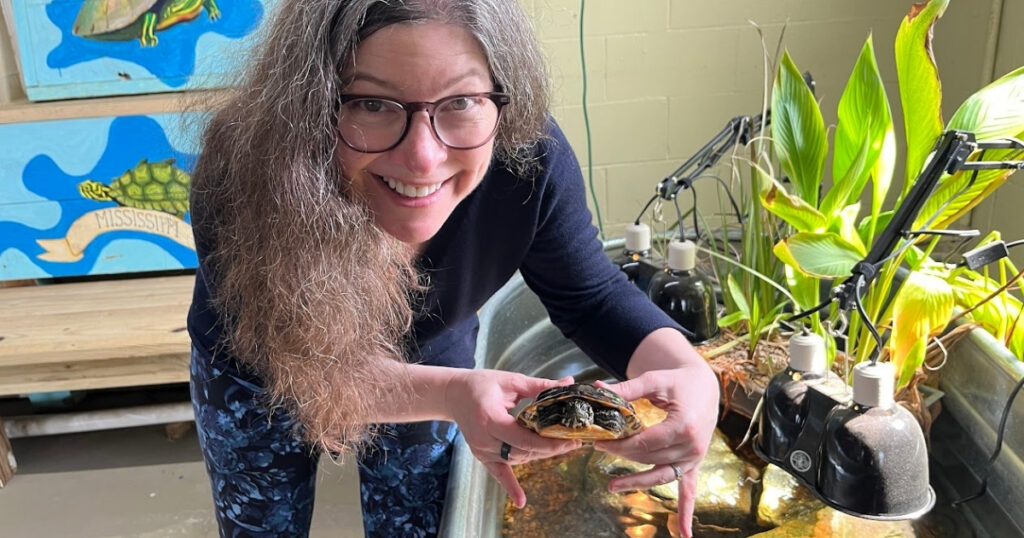
Kelly MacInnis So we’ve got these giant squares in the floor. And if we kind of looked all the way through them, they’re fairly deep. They were backfilled. And then we put a liner in and then we put these wetlands in this room. So this water is actually water from the Flint Creek. It pumps through this wetland. We have an interactive turtle tank and some fish tanks. So the water moves all throughout this room throughout the day. The plants are helping clean the water to remove some of that pollution, um, before ultimately this room overflows outside to more constructed wetlands that we have outside where the water continues getting cleaned. Um, but this room is really cool for kids, especially on rainy days. We can still do classes in here. We don’t necessarily have to be outside. So many kids have never held a turtle before. And so for some kids, it’s their first time interacting with turtles. And then our fish tanks are cool because they’re really a snapshot of what it looks like underneath the Flint Creek. They’re not pretty pristine fish tanks like you would think of in an aquarium. Um, we still have good water quality. Our fish are thriving, but it gives kids a chance to see what the creek really looks like.
Alex Hall Tell me more about the turtles. I didn’t see them when I first looked in. I guess they’re hiding.
Kelly MacInnis They’re pretty good at hiding. We have five aquatic turtles in here. These are river Cooters. Um. They’re aquatic. They’ll come out to bask, but they are really great swimmers. We’ve got a lot of hidey holes for them to hide in. Um, but whenever we come for field trips, they’re used to being handled. So we’ll let kids handle them very carefully, um, and interact with them a little bit to get to learn more about some of our native turtles.
Alex Hall If you’re just joining us, you’re listening to the Curiosity Squad, a production of w r I’m Alex Hall at Waterworks in Hartselle. You mentioned field trips. So that means obviously you have organized groups coming here. Tell me about how the center works and how people can get to experience it.
Kelly MacInnis So we do. Our bookings are by appointment only, so teachers can book field trips and bring their students. We have classes from preschool all the way through seniors, so we have a cute little preschool class. They’ll come. We read stories, we dig for worms all the way up to our high schoolers, where we’ll go canoeing or hiking, um, hopefully adding dissection soon. Um, we also do merit badges for scouts during the summer. We’re doing environmental science and nature. Um, and we do homeschool classes so that the homeschoolers can get to come and experience these same field trips. And then we also have a program called Friday Night Science, which is just for adults. So many times our adults come as chaperones on field trips and they say, oh my gosh, this is so cool. My kids are so lucky. I wish I got to do this too. And I’m like, why can’t you? So we now do these adult workshops about quarterly. We teach insect pinning. We’ve taught a class on microplastics. Later this year, we’re going to teach a class on the science behind sparklers and make sparklers. Um, so lots of really fun things going on.
Alex Hall Alec, tell me about some of the moments that you’ve had working here with, with kids or with adults. Is there anything that particularly sticks in your head as a real aha moment?
Ella Absher Oh yes. Absolutely. We had a group come from Heritage Academy close to Hoover, and these were high school kids that hadn’t been able to go on field trips in a very long time. And we had these kids come out and do our hike experience. It was a great time. And on our hike, at least when these kids were here, we had a section between two fallen trees where we had looked and we had found a ton of different mushroom species. And so we’d added into our hike like, hey, let’s go and look for mushrooms for a little bit. See what all you can find. We were supposed to be there for maybe fifteen minutes, but the kids loved it so much. We were there for over thirty minutes. They were running around looking for different species of mushrooms, yelling, I found this, I found this, look at this. And it was so incredible because the teacher walked up to us afterwards and was like, I have never seen these kids so engaged and interacting in nature. Not one of them had their phone out, and it was just really great to experience seeing these kids enjoying nature and getting out into it. Yeah.
Kelly MacInnis So this is our largest outdoor wetland that we have. So this is another one where we backfilled and put in a liner. There’s at least twelve turtles out here, but there could be more. You know, this is such a large space that it’s hard to tell exactly how many there are out here. There’s also fish in this deeper section of water. Um, our turtles and our fish kind of self-sustain their own populations. We just saw three little baby turtles out on a log. So that tells me that they’re doing good turtle things out here. And we have a lot of wetland plants growing cattails, pickerel, weed, different irises that are all really great at that nutrient uptake to help clean the water.
Alex Hall What do you hope most of your visitors will take away from their experience of this particular part of our environment?
Kelly MacInnis I really hope people leave with just a better appreciation for the environment. Um, when I was growing up, I spent all my time outside in nature. My parents were kind of come home when the street lights come home. So we just like, I don’t know, played outside, found fallen trees, made forts, things like that. And it just seems like kids don’t get that experience right now. And that’s where my love of nature comes from. It’s just that time as a kid. And so I hope to inspire kids to be interested in nature. There are so many things that they could choose from to be interested in. You know, you could become a plant person, a turtle person, a water person. You could specifically become a river cane person. There’s so many like niches that they could go into to find something that interests them. And I hope that they leave with the idea that the opportunities are endless. So we’re out here in what we call our forestry classroom. We teach a forest ecology class, and this is one of my favorite classes that we offer for our middle school and high school students. We’ve recreated a research project being done in paint Rock and come out here with kids with actual forestry equipment, so they get to measure and map these trees and learn about potential careers in forest ecology. If you look around at these trees, you’ll notice a little dog tag hanging off of each tree. And it’s how we identify each tree for the mock research that they do. So kids come out here, they get to collect all this data, and then we’ll actually send a follow up lesson plan home with our teachers for them to teach a lesson in their classroom with the data that their students collected.
Alex Hall What a great idea to turn this old facility into something that can teach. And thank you for doing all the hard work of putting the programs together.
Kelly MacInnis Thank you, and thank you for coming out and helping us tell people about what we’re doing. Because if they don’t know, they don’t know they come.
Ella Absher So thank you.
Alex Hall You can find information about waterworks on our Curiosity Squad web page at wlrh.org And if you go along, why not tell us what you thought using the public microphone on the WLRH app to record and send a message. Coming up next, our regular roundup from Geek Out Huntsville.
Part 4: Learning About Geocaching (32:09)
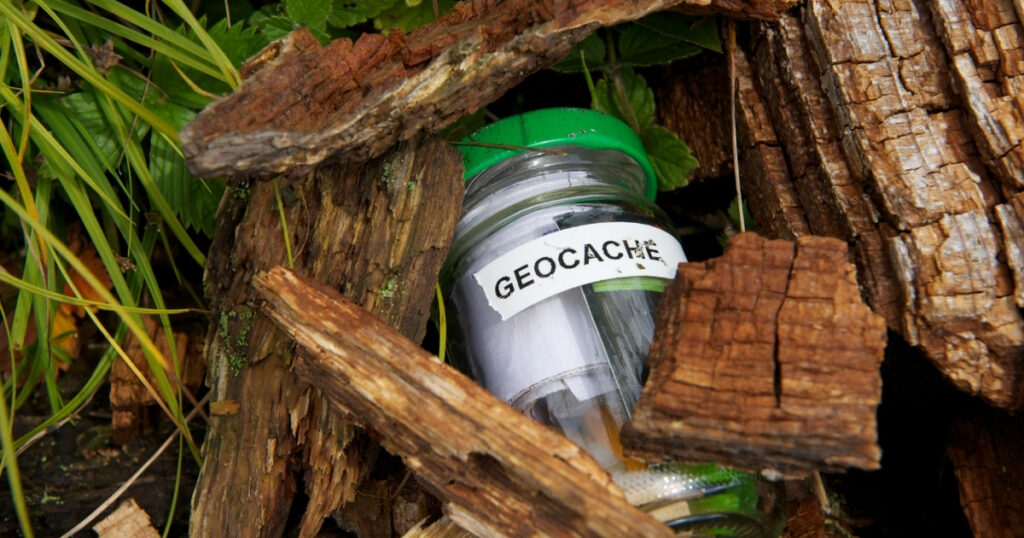
Alex Hall Welcome to the final segment of The Curiosity Squad, a production of WLRH I’m Alex Hall. Coming up at the top of the hour, our usual sky and space update from the Von Braun Astronomical Society, a group that’s been supporting Huntsville’s curiosity for more than seventy years. When we think of outdoor activities, we might think of scavenger hunts. An organized version of that is geocaching, and I spoke with local geocaching game for travel, who has been at this hobby for more than twenty years, and he can often be found teaching others how to get started.
Bobby Hall My name is Bobby Hall and I’m retired. I’m not affiliated with anything. The best book ever written. I don’t know what it is. That’s what I’m curious about. What is the best book ever written?
Alex Hall Bobby. What is geocaching?
Bobby Hall Caking is a wholesome hide and seek game using a GPS where you find hidden objects, usually outdoors, but not always, and you exchange swag and take or drop off travel bugs. Then log your adventures or sign the log sheet, then log your adventures online, and then tell your stories to friends that you meet at events or along the trail.
Alex Hall Geocaching involves using GPS satellites. So tell me about the history of GPS and the satellites.
Bobby Hall Well, it was designed during the sixties during the Cold War for military purposes. It was promised to be made available to the public, but when they did that, they included selective availability.
Alex Hall So that means it wasn’t quite as accurate as the military.
Bobby Hall Not very accurate. Do you like had find a paperclip in a football stadium and go, okay, it really wasn’t accurate to the public at all.
Alex Hall So when did this change?
Bobby Hall It was planned to be turned off in two thousand and six, but Bill Clinton signed an executive order that accelerated that date to May, the first of two thousand. It was turned off on May the second, and then on May third. Dave Ulmer in Oregon hit a five gallon bucket near Portland, and within three days, two guys who were already GPS users went and found it. And so the great American geo stash was born.
Alex Hall And that was the original name for. It was that was.
Bobby Hall The turns were being tossed around trying to find out a name for it. And then geocaching was suggested on May the thirtieth and a online magazine talking to GPS users used it, and then the New York Times used it shortly thereafter.
Alex Hall Well, once it was in the New York Times, then I guess it.
Bobby Hall Makes it official. It is geocaching.
Alex Hall There are different types of geocaching. There are different sizes and there are different things that you have to do. Is that true?
Bobby Hall Yes. Uh, there are about twenty different types of geocaches with different icons on the app map. You got your traditionals, which really just give you the coordinates and you go to it, you find it, you log it, you trade swag stuff, we all get drop in or take a travel bug. And then when you log it and put it back where you found it, maybe even better, but you don’t want to hide it so well that nobody else can find it. You’re done. That is the most common type of cash out there. Then you’ve got multis where you go to the posted coordinates for stage one. Usually you’ll find a piece of paper inside that will give you coordinates to the next stage, and you go to that and you find it. I don’t want to spoil any surprises. Might be a couple inches away from stage one.
Alex Hall And there are, um, there are kind of puzzle caches. Did I.
Bobby Hall Read.
Alex Hall That on the website?
Bobby Hall The next type I was going to talk about is the unknown category, which includes mysteries, puzzles, challenges, and bonus caches for Adventure Labs. For some of those, it’s better to go to a computer or laptop rather than using the app, because not everything on the website will show up on the app, but it could ask you things to work out or give you a cryptic code that you need to break. And they’re not always easy. A lot of fun. If you can find somebody to solve it for you, then they just give you the correct coordinates and then you go find it. And challenges are like, uh, it might say you need to find a hundred caches, at least one every day for a hundred days. And once you’ve done that, you can claim that challenge.
Alex Hall What is an earthcache?
Bobby Hall A very special arrangement with a geological association. They’ve got standards that you have to meet. You just go to somewhere in the world. Well, it gives you the coordinates, you know where to go. And you look at some part of the earth. Waterfall, rock structures. Rivers, creeks, streams, springs. Mhm. Did I say rocks? Lots of rocks. You look at a lot of rocks, and then they will explain things to you, and then you qualify to log it as a fine. You have to send answers to questions that the cache owner has at the bottom of the list.
Alex Hall Okay. So they’re trying to determine that you’re actually there and you’re looking at the particular.
Bobby Hall Right, because.
Alex Hall You.
Bobby Hall Could probably answer all the questions just by research a photo of you or something personal to prove that you were there.
Alex Hall You’re listening to The Curiosity Squad, a production of LH. I’m Alex Hall. Exploring the hobby of geocaching. You mentioned that in the cache, which can be teeny tiny or can be pretty big. Sometimes there’s a thing called a travel bug. What is a travel bug?
Bobby Hall Well, let me just say first. Every physical cast, the only thing that is required to be inside is a piece of paper for you to sign, and usually date if there’s room, and then put it back inside the cache before you hide the cache again. You can also have swag, which is stuff we all get. Usually not much of a treasure or very little value. They can be buttons, Happy meal toys.
Alex Hall And when when you take one, you you put a different one in, right?
Bobby Hall Yes. If you take something, you are supposed to leave something of equal or greater value.
Alex Hall Okay. For the next person.
Bobby Hall That is a standard etiquette practice. Yes. Then the travel bugs that you asked about the travel bug is a sequential unique code. Usually it looks like a dog tag as the original travel bug, and then usually attach what is called a hitchhiker to that travel bug, and then you give it a mission. Most travel bugs are. Their mission is just to travel from cache to cache. Some are a little bit more specific. They don’t want to be dropped into caches. They want to be taken and handed off to another cacher at an event.
Alex Hall But the goal with a travel bug is that this is something you’re picking up out of one cache, and you’re, you’re helping it fulfill whatever its mission is, whether it’s to get from one side of the US to the other.
Bobby Hall Or around the world.
Alex Hall Around the world or whatever.
Bobby Hall Or back and forth. I know some that like to go to Sydney, Australia, and then be found and have their picture taken with somebody named Sydney.
Alex Hall People can be pretty creative about what the mission is for their travel books.
Bobby Hall Yes.
Alex Hall Have you participated with travel books? What’s the furthest that you’ve had a travel bug go?
Bobby Hall I really don’t know. I’ve never analyzed that. I remember one, it was a little key change with a globe on it, and I think I was in California at the time when I released it, and the next thing I knew it was in Europe. I mean, almost immediately it had gone twenty three thousand miles.
Alex Hall It sounds like geocaching is a hobby that involves a lot of moving around and looking for things. How accessible is it to people who maybe have limited mobility or other disabilities?
Bobby Hall Well, let me say you can geocache for free. Well, basically just talking about using geocaching dot com and its apps. There are other apps and there are other services out there, but geocaching dot com is the most popular by far. One of the things that would be on a web page for a geocache is its terrain, and a geocache with a terrain of one is said to be accessible to somebody in a wheelchair that they alone can find, reach, retrieve, sign and replace the geocache without assistance.
Alex Hall Bobby, why do people get involved with geocaching? What are the key things that you think it are attractive to people?
Bobby Hall They don’t have a very busy life. It can be a very time consuming, but I know people that do it every day, working full time job and still somehow manage to find a cache every day. But after a while, that does involve a lot of driving. Because if you’ve found all the caches within five miles of your home, you might have to drive further.
Alex Hall Are there a lot of geocaches in and around the Huntsville area or the Tennessee Valley?
Bobby Hall I just happened to look that up. Within fifty miles of Huntsville, there are four thousand ninety two active caches. Alabama has almost fourteen thousand. The United States has over one million three thousand, and currently there are over three point three million active caches in one hundred and ninety one countries.
Alex Hall That’s a fairly big target. How many caches have you found, Bobby?
Bobby Hall Thirty four thousand six hundred almost. I’ve been at it for twenty years.
Alex Hall Are there memorable caches in those, Bobby, where you feel like, oh, I’ll always remember finding this particular one.
Bobby Hall Yes. I think my all time favorite is Mingo, which is the oldest existing cache. It has a GC code of thirty, so it was one of the original seventy five that started geocaching dot com. It’s located in western Kansas and I have been there three times.
Alex Hall Thanks again to Bobby for sharing his passion with us. If you have a curious hobby that you’d like to talk about or a topic that you’d be interested in us exploring on the show, please go ahead. Send me an email at [email protected]. Coming up next are Sky and space update from the Von Braun Astronomical Society.
Contributors
Casey Lanier
Marc Bendickson
Kelly McInnis
Bobby Hall
Links (Provided as a courtesy. WLRH is not responsible for external content)

Alex Hall
On-Air Host and Program Producer

Donate Your Vehicle to WLRH!
Support the programs you love by donating your old vehicle to WLRH!

Contact Your Local WLRH Hosts
Click here to contact WLRH hosts! You may also contact us by phone at (256) 895-9574 weekdays between 9 a.m. and 1 p.m.