
All Episodes of Tennessee Valley Mornings
Jun 10, 2026
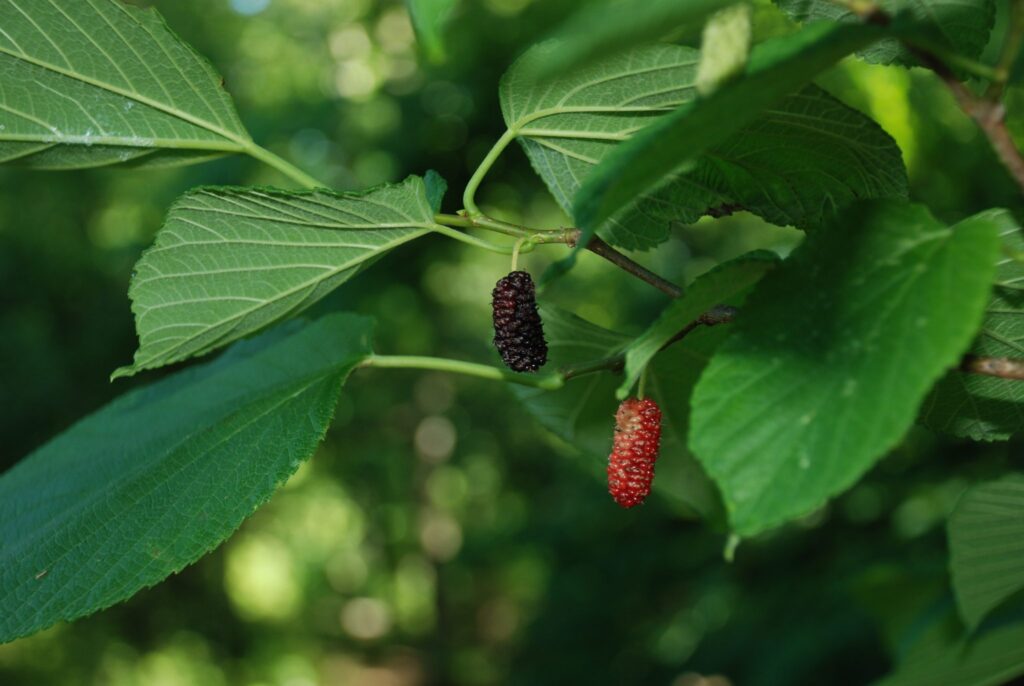
Five-ish Minute Forage – The Mulberry
Forager Casey Lanier tells us how to find and enjoy mulberries in his latest foraging adventure with Curiosity Squad host, Alex Hall.
Links (provided as a courtesy, WLRH is not responsible for external content)
Alabama Extension information on the mulberry
Transcript (generated by AI)
Alex Hall
I’m Alex Hall, host of WLRH’s Curiosity Squad. With spring in the air, I’ve been outside with our local foraging expert Casey Lanier. So Casey, describe what we are looking at.
Casey Lanier
So we are looking at not one but two mulberry trees, and if you notice, they’re not especially similar, and there’s a reason for that.
Alex Hall
Yeah, the leaves look to be different.
Casey Lanier
Yeah, they’re different in size. This one’s hairier, whereas this one is smoother. This one, the leaf tips are more acuminate, which is just fancy-speak for pointy, whereas this one, they don’t come to quite as strong of points, and that is because we have two species of mulberry in North Alabama.
The one with the bigger, hairier leaves is Morris rubra, American mulberry. The one with the less pointy, smaller leaves that are a little bit shinier, maybe, is Morris alba, which is called Chinese or paper mulberry.
Alex Hall
Has that one been introduced into Alabama, but maybe a long time ago?
Casey Lanier
Yeah, it is invasive. To me, on the scale of invasive plants, it’s not terrible, seeing as it has multiple edible parts. It doesn’t really seem to overcome the natives in the way that some of our invasives do, and frankly, if it was the only invasive plant, maybe it would be worth spending effort to get rid of it, but it’s not, and there are so many more that are more worth our time to fight against.
So today, we’re just going to talk about how great it is. So for both of our mulberries, there are two edible parts. The one that we’re looking at right now is the leaves.
So the young leaves on either plant are edible. So if we pinch some off, the American mulberry has a better flavor, but they’re a little bit hairy. I don’t quite love the texture.
Want to try one? Sure. Find one without a grasshopper on it.
It’s kind of weird with the fur. Yeah, it reminds me of eating a piece of felt or something, but the flavor is good. Some people will blend them up in smoothies or something that mask the texture a little bit and just get the nutrients and the flavor out that way.
The invasive mulberry, the texture is a little better, and the flavor is a little worse. They’re really some people’s favorite wild greens. I would not say so, but it’s a really cool edible part of the tree.
Alex Hall
So you would potentially just add that to a salad?
Casey Lanier
Yeah. Just the other day, I went for a walk at work and made a little wild salad out of leaves and berries and gave myself a little side dish to my sad desk ramen. So when does the mulberry tree get berries?
So the time is now. These are too small. This will become a full-size tree, but here at my house, this field’s only been growing up for about two years.
So these trees are about six feet tall, roughly, and you could have a tree that produces at this height, but to find one that’s actually producing right now, and we’ll see if there are any ripe, we’ll have to swing over to the edge of the field where there are some older trees. So this is a large example of the invasive paper mulberry tree. Something you’ll see is the berries that are on it right now are white.
The scientific name Morris Alba means white mulberry. It’s funny, that actually comes from sort of a misunderstanding. When the first English sailors and explorers and naturalists brought back mulberry specimens from China, they sent back a tree that the fruits ripened white and it got its name from that, but that tree was a one in a million aberration.
Most mulberries, the fruits start white and then ripen to black. They look almost exactly like a blackberry, and in fact, unless you’re very, very imaginative, if you see something that looks like a blackberry that’s growing on a tree, it’s a mulberry and you can eat it. Always do your own research, always double-check your identifications, but it’s one of the safest things you could eat in the wild is blackberries that are growing on trees.
Well right now we’re running into the problem where there are plenty of berries on this tree that have already matured, but we are racing the birds because they are better at getting up in the branches than we are, and so all they leave for us most of the time is these more immature ones. I’ve talked about masting with you before, where some like hickory trees especially around here or oak trees will produce very heavily in some years and then less in others to maintain a lower population of the things that eat their fruit or nut, and then some years produce an excess so they can’t all be eaten and they’ll go to seed. I haven’t read this, but from what I’ve observed it seems like mulberries do more or less the same thing, where every few years you’ll just have a really good year and a lot of mulberry trees will make so much fruit that the animals can’t keep up, and that’s when we really get to stock up.
The downside is they do have a little stem in the middle that you have to either ignore and eat or spit out. Also if you’re making things out of mulberry and you just want the pulp you can like smoosh it through a grater or strainer or something. I did want to mention, so I like to talk about some of the other uses of plants other than edibility, and the white mulberry in particular is a very significant tree in a lot of East Asian economies and cultures.
So if you’ve ever heard of the silkworm, silkworms eat primarily white mulberry leaves. It’s one of the only places where they’ll live, so white mulberries were cultivated in East Asia for silk and have been for thousands and thousands of years. If you’re familiar with taxonomic rankings, it goes, you know, domain, kingdom, yada yada yada, all the stuff you learned in school.
The only two we usually use when we’re talking about plants are genus and species. So with mulberry that is Morris, Alba, and Morris, Rubra. Well if you go one step up from there to family, mulberry is related to Osage orange.
There are a few signs of that. One is that everything in the family that they’re in, which is morassiae, has latex in pretty much all parts of the plant. So if we tear this guy off, you see how there’s a little bit of white latex coming out of the broken areas of the plant?
Alex Hall
Oh wow, yeah, I see that. So actually if you have a latex allergy, you probably don’t go eating the mulberry?
Casey Lanier
Yeah, that’s correct. Anything in this genus, as well as your lettuces, there are a lot of plants with latex in them. Similarly, they both, so Osage orange is well known as the best bow wood in North America for, you know, hunting bows, archery.
Mulberry is not as dense or hard as Osage, but it was used as the core component of a lot of Eastern Asian bows. So the Japanese Yumi, for example, is a very unique style of longbow that often would have used a mulberry core laminated with bamboo. Korean archers would have used a mulberry core laminated with horn and sinew, so animal parts, to make an extremely advanced bow.
It’s been a very significant tree for thousands and thousands of years, and we can still find it and eat it today.
Alex Hall
Thanks to Casey Lanier for sharing his passion for foraging. You can find this story and others with Casey on our website at WLRH.org. For Tennessee Valley Mornings, I’m Alex Hall.

Erich Brukner
General Manager, WLRH-FM | Division Director of Radio, Alabama Public Television

Marsha Arends
On-Air Host & Producer

Katy Ganaway
Program Director and Host of Arts Underground

Alex Hall
On-Air Host and Program Producer

Bob Nance
Producer

Contact Your Local WLRH Hosts
Click here to contact WLRH hosts! You may also contact us by phone at (256) 895-9574 weekdays between 9 a.m. and 1 p.m.

Donate Your Vehicle to WLRH!
Support the programs you love by donating your old vehicle to WLRH!