
All Episodes of Tennessee Valley Mornings
Jun 25, 2026
Five-ish Minute Forage – The Wild Plum
Alex Hall learns about the local Chickasaw and other wild plums that are starting to fruit at this time of year.
Transcript (automatically generated)
I’m Alex Hall, host of WLRH’s Curiosity Squad. As summer is approaching, I’ve been outside with our local foraging expert, Casey Lanier, to learn all about wild plums.
Casey Lanier
This is a wild plum. They’re both in the genus Prunus. There are about six species of wild plum in our area.
I believe this is Prunus americana, but honestly, many of them are so similar that it’s very hard to tell apart. And from an edibility standpoint, it’s not always worth it, because all of our plums are edible. Well, I guess first off, to point out some similarities that you can tell with pretty much all of the genus Prunus, is the leaves are alternate.
They’re mostly ovate, which is basically round. They come to fairly pointy or acuminate tips. They’re all serrated along the edges.
And like black cherry, this has fairly smooth bark with prominent lenticels. A couple things you’ll notice that make a difference is plum has these big spines on it. They’re pretty big and intimidating, but not actually all that sharp.
You can tap one pretty good and it won’t get you like a honey locust or something would. Oh yeah, that’s pretty smooth. Also, the bark isn’t quite as light of a gray, and plum trees tend to stay much smaller.
Black cherry is a viable lumber species. The largest ones can get pretty substantial comparative to other hardwoods, not quite as big as an oak or something. On the other hand, a plum, if you see that one back there that’s about 15 feet tall, that’s pretty close to as big as I’ve seen them.
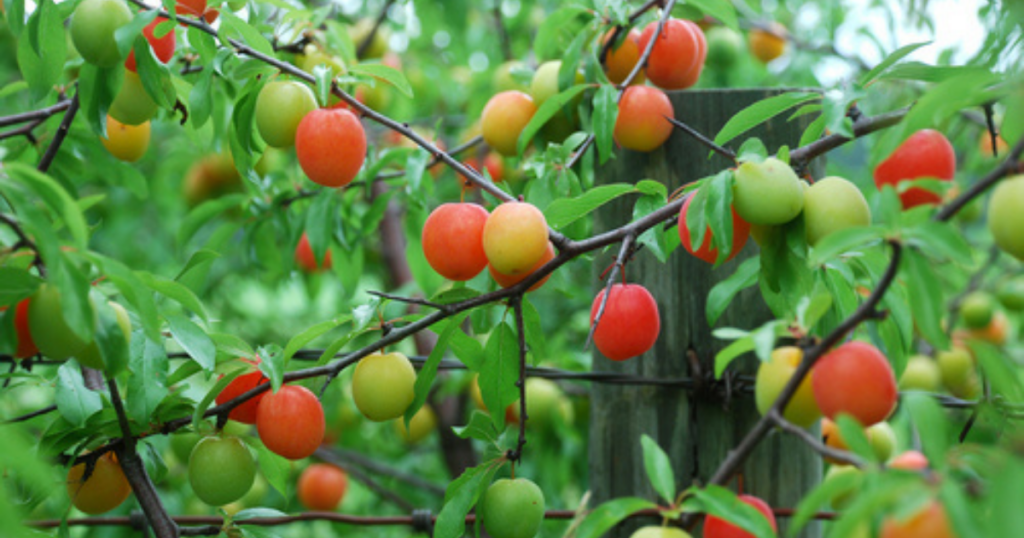
I’ve seen one that was maybe as big around as my leg, and that’s about as big as you’re going to get. Wild plums make a fruit that looks an awful lot like a domesticated plum. In particular, the one that ripens in mid-spring, mid-May and on pretty much, is called Chickasaw plum.
And that one is genuinely delicious. They look almost exactly like domesticated plums, and they have sweet fruit, mildly tart skin, and yeah, it’s just like the best little garden plum you’ve ever had, which if you haven’t had one, absolutely blows the doors off grocery store plums.
Alex Hall
But I don’t see any plums on this particular shrub here.
Casey Lanier
So there are a few. We’re going to have to peek back. Let’s go around to the right here.
Alex Hall
Oh, I see there’s some. They look very green.
Casey Lanier
Yeah, and that’s one of the things that makes me think that this is American plum, or Prunus americana. The plums are still small, green, and very hard at a time of the year when Chickasaw plums would be ripening. So Chickasaw plums ripen the earliest, and our other species ripen variously throughout the summer.
So the fact that these guys are nowhere close to ripening and also not as round and plump as Chickasaw plums are make me think that this is probably American plum. This one, maybe if you’re listening to it in June to sometime in July, the American plums in your area may be ripening. And plums, especially the ones other than Chickasaw plum, the flavor is quite variable from plant to plant.
Meaning that you can have one plant where they’re absolutely delicious, and another where the bitter stuff in the skin is kind of overwhelming. In those cases, you can just smash the pulp away in a strainer or something and not eat the skin. And all plums will have a pretty flavorful, good flesh to them.
But the big thing is, if you’re going to plant them in your yard, if you find seeds from a particularly delicious wild plum, plant them in your yard, they’ll have a better than average chance of making particularly delicious babies.
Alex Hall
So the fact that these plums are ripening at different times, is this something that you can use if you’re trying to optimize for foraging? You can try and identify different plum species around about, so you know some are going to be ripe at this time of year and some are going to be ripe in, say, two months’ time?
Casey Lanier
Oh, absolutely. There’s two places I know of, one on Research Park and one kind of nearby, just off 565, that have Chickasaw plums. And I’m probably going there this weekend to fill a basket.
And then, I haven’t been as familiar with American plums until I had them on my property and started looking into them more. But hopefully, later in the summer, I’ll have a few. And as I continue to let them grow up all over my property and clear out the area around them, I should get more and more, year after year.
There is one more thing I wanted to talk about. And that is, if you talk to older people who used to forage in America, say, 50 years ago, my dad used to go out with his parents. His parents had lived through the Depression, and so they were very excited about wild food.
First, out of necessity, and then later because they enjoyed it. And they would go get plums all the time. And they were absolutely everywhere.
And pretty much anyone of that era that you talk to will say, I just don’t know why there aren’t plums everywhere like they used to be. And I think there are three main reasons for that. The first one, which we’ve talked about a little bit before, is invasive species.
Some of the worst invasive species in this area, like Chinese privet and bush honeysuckle, and to a lesser extent tree of heaven, which is still pretty bad, just not quite as bad as the other two, live in almost exactly the same kind of border habitat as plums do. Plums, because they don’t get large, can’t thrive in the middle of the forest. They’ll get shaded out by larger trees.
They also can’t survive in a mown lawn because it takes them several years to mature to the point where they can fruit. So they need areas that are close to the edge of a forest where they might get knocked down every few years, can be left alone for several years to really do well. You’ll still find habitat like that.
I would argue that there might even be more habitat like that than there would have been for most of at least colonial American history because we’ve developed so much land. There’s all of the little borders along the side of roads, along the side of your apartment complex, the little tree line by where I work that fits the bill perfectly. And yet if you go to those places, what do you find?
Chinese privet, bush honeysuckle, tree of heaven. The second reason, and something that would have helped out plums more in early American history, would have been fire. So it’s another way of kind of resetting big areas of a forest every now and then.
There’s some debate about how much of Eastern America would have been subject to regular fires. But in any case, now that answer is basically none. So forests can progress to old growth forest and just stay there.
And it knocks things like plums out of those whole areas. The third thing, and this is an interesting one for Chickasaw plum in particular, when we have early European ethnobotanists writing records of the plants that they found in North America, Chickasaw plum, which is named after an Indian tribe that was living in this area, was found almost exclusively close to Indian habitations. And I think it was a little bit of sort of European arrogance that kept people from realizing this, but that was almost certainly a form of agriculture where they would do more or less what I’m doing now, take plants that are in the area already that are wild, pick their best descendants, and engage in a form of sort of proto-domestication where you keep them growing in the areas around you and then harvest them from their semi-wild environment and manage those environments for greater productivity.
That brings us to our third category of things that could help the plum populations and did in the past that aren’t as much anymore, and that’s deliberate propagation by humans. So if you have this delicious thing in your area and you form a relationship with it by going out and harvesting it, you’re naturally going to say, Huh, what if I got these started at my house? What if I collect some seeds and sprout them and put them in the edge of my yard?
And that brings you to the point where suddenly foragers go from a lot of people’s perceptions as, Ooh, they’re bad for the environment. They’re taking from nature. Haven’t we already taken enough garbage like that?
To people who are the only ones who care about these plums, these delicious native species, enough to bring them to your house, to grow them, to do what I’m doing and manage my entire field to maximize the productivity and population of these really cool native plants.
Alex Hall
Thanks to Casey for sharing his passion for foraging. You can find this story and others with Casey on our website at WLRH.org. For Tennessee Valley Mornings, I’m Alex Hall.

Erich Brukner
General Manager, WLRH-FM | Division Director of Radio, Alabama Public Television

Marsha Arends
On-Air Host & Producer

Katy Ganaway
Program Director and Host of Arts Underground

Alex Hall
On-Air Host and Program Producer

Bob Nance
Producer

Contact Your Local WLRH Hosts
Click here to contact WLRH hosts! You may also contact us by phone at (256) 895-9574 weekdays between 9 a.m. and 1 p.m.

Donate Your Vehicle to WLRH!
Support the programs you love by donating your old vehicle to WLRH!