
All Episodes of Tennessee Valley Mornings
Jun 24, 2026
A Solstice Discovery: The Ancient Monument That Came Before Stonehenge
As people around the world marked the summer solstice, archaeologists in England unveiled findings that could reshape our understanding of one of humanity’s most famous monuments. A newly analyzed site near the village of Bulford in Wiltshire reveals that prehistoric people were tracking the sun’s movements with remarkable accuracy some 5,000 years ago, centuries before the massive stones of Stonehenge were raised.
Alex Hall explores the discovery with insights from archaeologist Phil Harding of Time Team fame and Stonehenge expert Dr. Matt Leivers. Their research suggests that two simple wooden posts, aligned to the summer solstice sunrise and winter solstice sunset, may represent one of the earliest known examples of people deliberately constructing a monument to precisely mark the sun’s position on the horizon.
The findings offer a fascinating glimpse into how prehistoric communities understood time, seasons, spirituality, and their place in the cosmos. They also highlight the often unseen work of modern archaeology, preserving traces of the past that might otherwise disappear beneath contemporary development.
Curiosity Squad host Alex Hall brings us a story about ancient skies, enduring human curiosity, and a discovery hidden in plain sight for thousands of years.
Links (provided as a courtesy, WLRH is not responsible for external content)
Press release at Wessex Archaeology.
Transcript (automatically generated)
Alex Hall
I’m Alex Hall, host of WLRH’s Curiosity Squad. This past weekend was the summer solstice, and I had been hoping to go up to Blevins Gap to watch the sunset over Huntsville on the longest day of the year, but the weather has been very unsettled, so instead from Wiltshire in England, a discovery that may change how we think about Stonehenge itself. The site is at Bulford, and it was excavated by Wessex Archaeology.
Wessex Archaeology is one of the UK’s major archaeological organisations. It’s also a charity. A lot of its work is what you might call rescue archaeology, recording and understanding what’s in the ground before a modern development goes ahead.
The lead archaeologist was Phil Harding, familiar to a lot of armchair archaeology fans from the long-running British TV series Time Team. He was joined in interpreting the site by Wessex Archaeology’s Dr Matt Levers, a Stonehenge expert. Here’s Phil Harding.
[Harding]
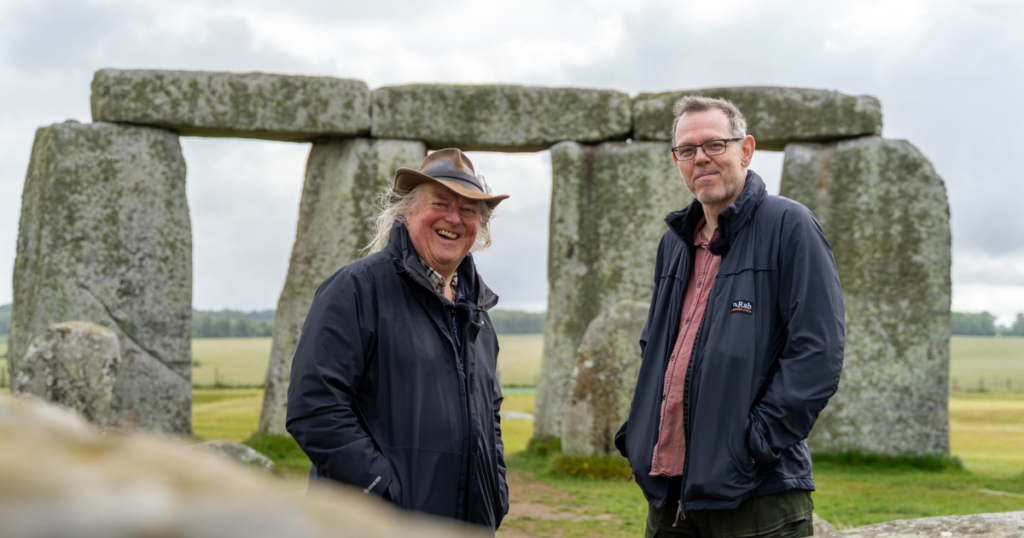
It is amazing to be standing here at Stonehenge and to have the monument all to myself. And yet, in a few days’ time, this whole area will be absolutely cramming with people, all here to celebrate the mid-summer solstice as the sun rises over the Heelstone. And yet, what few of them will understand is that 5,000 years ago, on a rather bleak hillside overlooking the village of Bulford, five kilometres in that direction, a group of people were doing exactly the same thing.
That’s 5,000 years ago, but the important thing is, it’s 500 years before these magnificent sarsens were brought to Stonehenge. That is important. So what exactly did they find?
Well, what we’ve discovered at Bulford is a part of a site which has got two post holes, or post pits, which would have had two posts in it aligned on the mid-summer sunrise. Exactly the same as you’ve got here. But the important thing is, firstly, it’s the accuracy with which that they’ve done it.
And secondly, it’s 400, 500 years before these big stones were brought to Stonehenge.
Alex Hall
Dr Matt Levers talks about why this is important.
[Leivers]
What’s happening at Bulford is that it’s the first time that we know of that people are moving from that general looking in the direction of the sun to pointing straight at it. And that’s the really important thing. They’re building something that points directly at this thing they’re interested in, rather than just a thing that looks in the general direction of it.
Alex Hall
And the striking thing is how simple it was. Two posts in a line. But according to the analysis by skyscape archaeologist Dr Fabio Silva, the line matched the solstice within about a degree.
And for Phil Harding, that simplicity is part of the wonder.
[Harding]
The thing I love about our alignment at Bulford is its simplicity. It is two posts in a line. But the important thing about that alignment is that they are aligned on the summer solstice and on the mid-winter sunset as well.
Exactly like at Stonehenge. But it’s that simplicity of having two posts in a line. And it’s just as accurate.
It’s that wonderful pieces of simple surveying where you range in a line. And to get it to one degree error, that is really accurate surveying. They knew where that sun was going to come up.
Alex Hall
Today we may think about solstice as the official start of summer. But for prehistoric communities, Matt Leivers says the solstice was much more than that.
[Leivers]
The solstices, when we’re talking about the solstices, what we’re talking about is religion. We’re talking about how these people in prehistory understood the cosmos and the world and their place in it and how they thought they related to their spirits and gods and goddesses and all these kinds of things. And if you think about it, when you’re on to gather a community or agricultural community, everything you do depends on the sun.
It depends on the sun being there when it’s supposed to be there, not being there when it’s not supposed to be there. And those cycles of things carrying on. Solstice, that word, it means when the sun stands still.
And the summer solstice and the winter solstice are that point in the year when the sun is in the same place on the horizon for a few days. So it’s the point where the year pauses. The briefly in the middle of summer and the middle of winter.
It’s a way of keeping track of the passage of time. And I think what things like your posts at Bulford and the celebrations that would have gone on there and what’s happening here at Stonehenge and all those kinds of things. It’s a way of celebrating that, but also making sure that it keeps working for you.
It’s your way of saying to your deities, please keep us in mind and keep going and keep us warm and safe and fed and all those kinds of things. It’s a direct religious event.
Alex Hall
Archaeology is not for the impatient, with some tests and analysis taking a very long time.
[Harding]
When I first discovered this or realised that what I actually had was that important, it was like a kid in a toy shop. It was one of those giggle moments. And I just really could not believe that what I’d lived with for at least three years, unconfirmed, had now been confirmed.
I reckon it’s probably one of the greatest finds of my career. It is that important to me. It really is.
Alex Hall
And for something this important, you’d think there’ll be a new sign erected, perhaps some new tourist destination.
[Harding]
Finding remains at Balfour makes me incredibly proud to be an archaeologist. People will say, you’ve made these wonderful discoveries that tell us all about the past. Can I go there and see it for myself?
No. It is now a housing estate. People live there.
There is nothing to see of our discoveries, except the records that we compiled. That is why archaeology is so important in the modern world, because it preserves evidence of the past for future generations.
Alex Hall
I don’t know about you, but hearing that from Phil makes the hairs rise on the back of my neck. My local solstice outing did not happen, but instead I got an amazing reminder that the solstice is not just about one sunrise in one place. It’s about people looking at the sky all over the world and trying to understand where they are in the turning of the year.
At Bulford 5,000 years ago, people were doing just that with two posts on a Wiltshire hillside. Centuries later, people were celebrating just down the road at Stonehenge. We have links and images from Wessex Archaeology on the WLRH website at wlrh.org.
For Tennessee Valley Mornings, I’m Alex Hall.

Erich Brukner
General Manager, WLRH-FM | Division Director of Radio, Alabama Public Television

Marsha Arends
On-Air Host & Producer

Katy Ganaway
Program Director and Host of Arts Underground

Alex Hall
On-Air Host and Program Producer

Bob Nance
Producer

Contact Your Local WLRH Hosts
Click here to contact WLRH hosts! You may also contact us by phone at (256) 895-9574 weekdays between 9 a.m. and 1 p.m.

Donate Your Vehicle to WLRH!
Support the programs you love by donating your old vehicle to WLRH!